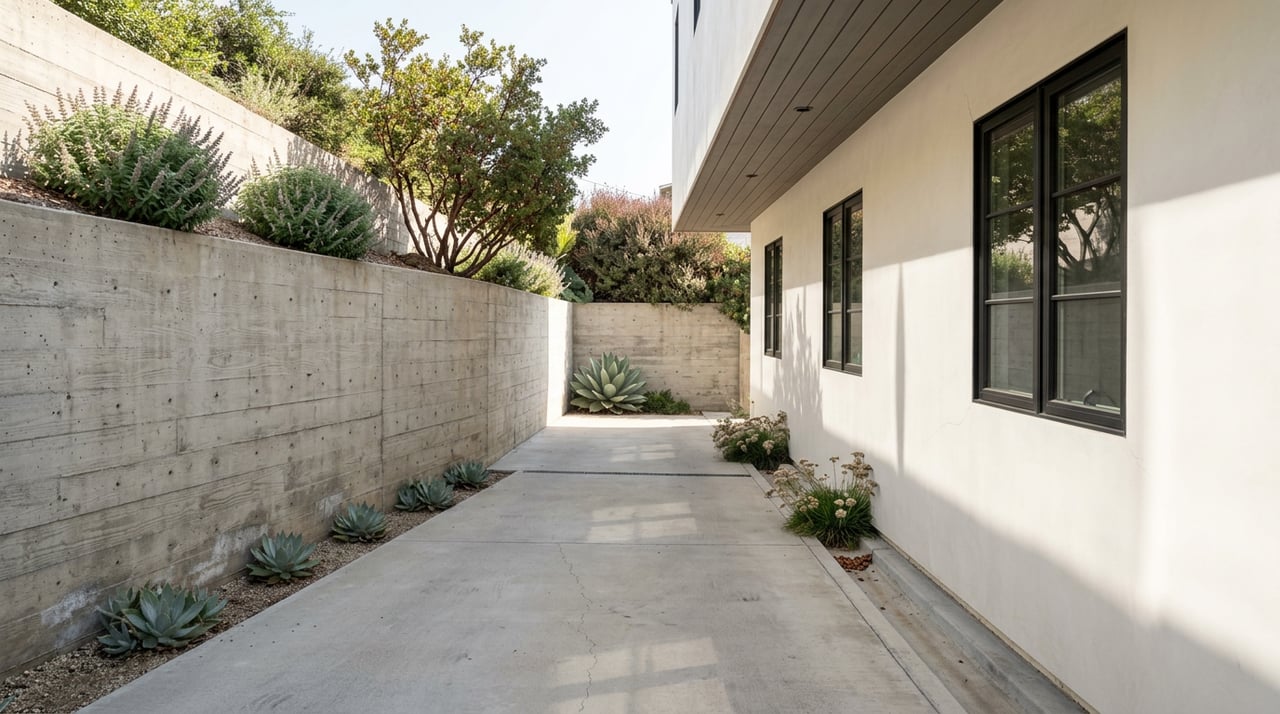
What Your Money Actually Buys in Glassell Park Right Now, And Why It's Priced That Way
August 6, 2026
August 6, 2026
If you have been shopping Northeast LA for more than a weekend, you already know the headline. Glassell Park is the affordable one. Eagle Rock is the family pick with the walkable boulevard. Highland Park is the nightlife corridor with the Gold Line stop. The medians confirm the ranking, and most guides stop there.
The problem is that the Glassell Park median is a blended number pulled from two different housing markets separated by a freeway, and the "discount" it implies is quietly closing for reasons that have nothing to do with the median itself.
Glassell Park is not one market. It is a flatland market and a hillside market averaged together, with a pre-1978 small-multifamily overlay sitting on top of both. When you compare its median to Eagle Rock's or Highland Park's, you are comparing an average of two products to a single product. That is where the "value" narrative gets sloppy, and it is where a careful buyer finds either a real deal or an expensive misread.
Here is the current picture as of mid-2026, pulled from the reports that track this submarket most closely.
| Neighborhood | Median (mid-2026) | Days on market | What roughly $1.2M gets you |
|---|---|---|---|
| Eagle Rock | ~$1.3M | ~26–40 | ~2,000 sq ft, often with hillside view or yard |
| Highland Park | ~$1.1M–$1.2M | ~35–58 | ~1,500–1,700 sq ft, updated historic, smaller yard |
| Glassell Park | ~$1.09M–$1.20M | ~34–43 | Varies widely by hillside vs flatland |
Two things pop out. First, the Glassell Park range overlaps almost entirely with Highland Park, not with the discount narrative that dominated 2018 through 2022. Second, days on market in Glassell Park sit in the middle of the pack, not at the "harder to sell" end, which is what you would expect if buyers actually saw it as second-tier.
The reason the ranges overlap is that a move-in ready bungalow on the Glassell Park Loop side routinely closes above $950,000, while fixer stock along parts of Verdugo Road still trades in the $720,000 to $800,000 band depending on lot and ADU potential. The median is the middle of that spread, not the price of any actual house.
The 2 Freeway cut Glassell Park in half in the early 1950s, and that cut still defines the market today. Flatter sections south and west of the freeway are more developed, with more housing communities and restaurants and easier commutes to Downtown or Glendale. The hills above are a different product entirely: stricter hillside building codes, more custom architecture, stairs instead of driveways, homes spaced further apart, and less through traffic.
That is not a lifestyle observation. It is a pricing structure. Hillside lots with panoramic views of the San Gabriels or Downtown carry a premium that pulls the top of the range past $2M. Flatland bungalows on standard lots anchor the bottom of the range. When a buyer says "the Glassell Park median is $1.1M," they are describing a number that no single house is actually priced at. You are either bidding on the flat side or the hill side, and the comps that matter are the ones from your side of the freeway.
Practical read for a buyer: get your agent to pull comps by micro-pocket, not by ZIP. The 90065 median that shows up on portal pages is mixing Mount Washington-adjacent hillside inventory with flatland stock near Cypress Park. That number is not your comp.
There is a structural reason Glassell Park pricing has firmed up even as the broader LA market softened. Lincoln Heights and Cypress Park, both priced below Glassell Park, have been appreciating faster than the neighborhoods above them, in the +7% to +8% range year over year. That is the classic Northeast LA pattern: buyers priced out of one rung look one step up the ladder, and Glassell Park is the next logical step for buyers coming out of Cypress Park and Lincoln Heights.
At the same time, Eagle Rock and Highland Park buyers who miss on inventory keep drifting west along the 2 Freeway corridor into Glassell Park. Demand is arriving from below and from beside, and inventory is not keeping up.
A useful way to think about it: Glassell Park is no longer priced as a discount to Northeast LA. It is priced as value relative to Northeast LA. Those are different trades. A discount closes when the market notices. Value holds if the underlying reason for it holds.
Commercial fill-in is the lagging indicator that tells you which way a residential market is drifting. Glassell Park's commercial corridor, Verdugo Road, has spent the last few years quietly getting the kind of density that Eagle Rock's Colorado Boulevard and Highland Park's York and Figueroa already have.
The anchors buyers are actually paying for when they choose this side of the freeway:
That list would have looked thin five years ago. It does not look thin now. When a buyer weighing Eagle Rock against Glassell Park says "but there is nothing to walk to in GP," the honest answer in 2026 is: less than Eagle Rock, more than the median-price gap suggests. The commercial corridor is why the residential discount is compressing.
If you are looking at Glassell Park for a 2-to-4-unit or a small apartment building, everything above is background. The foreground is a state and local rent framework that changes the math.
Almost all pre-1978 multifamily inventory in Glassell Park is subject to the Los Angeles Rent Stabilization Ordinance, which caps annual rent increases and constrains no-fault evictions. Buildings constructed after October 1, 1978 generally fall outside that framework. In practice, the RSO overlay means:
Glassell Park has drawn steady 1031 exchange interest because buyers exiting appreciated assets elsewhere see it as a growth-oriented submarket relative to Eagle Rock and Highland Park. Those buyers are on a 45-day identification window and a 180-day close, which creates real urgency at specific moments and means a well-timed listing can outperform a lazily-timed one by a wide margin.
None of that shows up on a portal page. All of it shows up in an actual transaction.
A short checklist for anyone actively shopping:
Is Glassell Park still cheaper than Eagle Rock? On paper, yes. In mid-2026 the medians are roughly $1.1M to $1.2M in Glassell Park versus around $1.3M in Eagle Rock. In practice, the gap narrows sharply on hillside inventory with views, and it widens on flatland fixers.
Are prices going up or down here? Reports diverge in the short term. Some show a slight year-over-year dip in median; others show mid-single-digit gains on single-family. The underlying migration pattern from Cypress Park and Lincoln Heights argues for firm pricing through 2027, but macro rates and inventory can move that either way.
Is buying a small apartment building in Glassell Park a good idea? It is a specific decision with specific variables: RSO status, soft-story exposure, insurance, in-place rent versus market rent, and whether your capital is on a 1031 clock. Any of those can flip the outcome. Do the underwriting on the actual building, not on the neighborhood story.
What is the one thing most buyers get wrong? Treating the ZIP-level median as a comp. 90065 is too big to price a specific house, and the freeway-driven split means the average of the two sides tells you nothing about either.
If you are weighing Glassell Park against its neighbors and want the comps pulled by pocket rather than by ZIP, the team at The LA Home Girl Team will run the numbers on the specific block you are considering and tell you whether the listing price is the story or the setup. Help Me Sell if you are on the other side of the trade and want to know what your Glassell Park home would look like against current inventory.
Stay up to date on the latest real estate trends.


Experience the advantage of working with a collaborative team that prioritizes strategy, service, and exceptional outcomes.