What's In A Mortgage? Breaking Down the Components of A Mortgage Payment
Buyer The LA Home Girl Team (Compass) May 31, 2018
Buyer The LA Home Girl Team (Compass) May 31, 2018
In simplest terms, a mortgage is a long-term loan designed to help borrowers purchase a house. It allows individuals to become homeowners without making a large down payment and thus, fulfilling The American Dream. Once you become a homeowner, a mortgage represents one of your life's biggest financial commitments. So it's important to understand the structure of your payments — what percentage goes to principal, interest, and taxes, and what you currently owe on your loan balance.
I'm a first-time home buyer. Once I closed on my new home, when will my mortgage payment start?
Mortgage payments usually start one full month after the last day of the month in which the home purchased closed. Unlike rent payments, which are usually paid in advance on the first day of the month, mortgage payments are paid in arrears. It means the payment is expected to be made at the end of the month. For an instance, after closing on your new home on March 28, the first full mortgage payment, which is for the month of April, is then due on May 1.
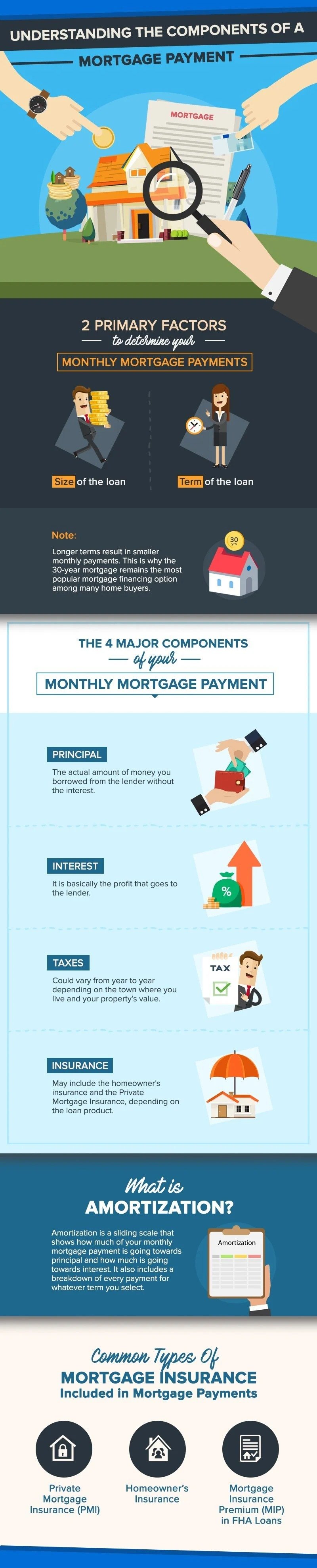
Size of the loan - refers to the amount of money borrowed.
Term of the loan - the length of time within which the loan must be fully paid back.
Remember: Longer terms result in smaller monthly payments. This is why the 30-year mortgage remains the most popular mortgage financing option among many home buyers.
The actual amount of money you borrowed from the lender without the interest. It is the face value of your mortgage on the first day. For an instance, if your mortgage is $250,000 with a 4.5% interest rate, your principal remains at $250,000.
A portion of each mortgage payment goes to the repayment of the principal. If you take a mortgage with a fixed-interest rate, your principal repayment will be the same for the life of the loan. A greater amount of the principal is paid during the back half of the loan because the majority of the payment in the first few years goes primarily to interest.
To calculate your starting principal balance:
Principal Balance = Purchase Price + Fees Rolled into Mortgage - Down payment
The interest is another big part of your mortgage payment. It is basically the profit that goes to the lender. Think of it as the lender's reward for taking a risk and lending money to a borrower. Lenders will want to earn their interest back in the first few years of the loan repayment before they start reducing principal. Meaning, the majority of your mortgage payment goes to the interest in those first few years, but every month you pay down a little bit of principal as well. This is the method banks use to protect themselves in the event of a default. But the more payments you make, the lesser amounts go to interest and a bit more goes to the principal. For a 30-year loan, the first seven years will go mostly towards the interest.
Higher interest rates = higher mortgage payments
Interest is accrued annually regardless of whether you have a fixed-rate mortgage or an adjustable-rate mortgage. It’s important to note that the interest rate on a mortgage has a direct impact on the size of a mortgage payment. The average 30-year fixed-mortgage rate until March this year is 4.54%, which rose slightly higher since November 2017.
To calculate how much of your payment goes to interest:
Interest Portion = Current Principal Balance 𝒙 (APR ÷ 12)
Amortization is a sliding scale that shows how much of your monthly mortgage payment is going towards principal and how much is going towards interest. It also includes a breakdown of every payment for whatever term you select. To have an idea of where your monthly payment typically goes, visit your lender’s website and print off a copy of your amortization schedule. There are also free amortization schedule calculators online that you can use as a guide to estimate the monthly payment on your mortgage.
Almost all lenders require you to include, or escrow, the taxes into your monthly payment. It is because property taxes take first priority over everything else. The tax portion of your payment could vary from year to year depending on the town where you live and your property’s value. Real estate taxes are assessed by governmental agencies and used to fund various public services, including the school district, road construction, the police and fire department services, and others.
The amount that is due in taxes is divided by the total number of monthly mortgage payments in each year. If you escrow, you place the next tax payment in advance with your lender and they pay the taxes for you. If you have an extra amount in your escrow account at the end of the year, your lender may cut you a check and then simply roll it over to next year.
Insurance payments, just like property taxes, are also part of each mortgage payment and held in escrow until the bill is due. This is done to ensure that you are always covered in the event of an emergency. The taxes and insurance typically don’t experience much fluctuation, unless there is a run on foreclosures or if your neighborhood was hit by weather issues, then it could change significantly.
This type of insurance is mandatory for homeowners who purchased a home with a down payment of less than 20% percent of the home’s purchase price. It protects the lender from financial loss in the event that a borrower defaults on the loan. The rates for PMI differ from loan to loan and depends on several factors, including the borrower’s credit and the amount of down payment. Typically, this insurance costs between 0.3% to 1.15% of the mortgage loan amount.
For most conventional loans, the payment for PMI is necessary until you have at least 20 percent equity in your property. A borrower also has the option to choose from different payment plans: annual, monthly, and upfront payment.
This is a form of property insurance that covers losses and damages to an individual’s house and assets in the home. It also provides liability coverage against accidents in the home or on the property. Homeowner’s insurance is often bundled with mortgage payments. It’s important that homeowners educate themselves on the amount of their homeowner’s insurance premium every month.
The MIP is an insurance policy used in FHA Loans. It protects lenders against losses that result from defaults on home mortgages. In an FHA loan, both upfront and annual mortgage insurance are required for all borrowers, regardless of the amount of down payment. Borrowers can check the annual MIP rates on the FHA website.
Stay up to date on the latest real estate trends.









Experience the advantage of working with a collaborative team that prioritizes strategy, service, and exceptional outcomes.